Wet or Damp Basement? Diagnose It, Then Fix It
Use a symptom-led checklist to distinguish leaks, groundwater, condensation, and indoor moisture before spending on basement waterproofing.
A wet or damp basement can be caused by rainwater entering around the foundation, groundwater pressure, a plumbing leak, humid air condensing on cool surfaces, or moisture already inside the home. The right fix depends on the source. Start with safety, note when moisture appears, inspect drainage outside, and measure indoor humidity before choosing a repair.
Safety first: Never walk into standing water if it may contact outlets, appliances, wiring, or an electrical panel. Do not touch wet electrical equipment. Leave the area and contact the power utility, emergency services, or a qualified electrician as appropriate.
Five clues that help separate common causes
| What you notice | Possible explanation | What to check next |
|---|---|---|
| Water appears after heavy rain, particularly at one wall or window | Surface drainage, window well, foundation joint, or groundwater | Gutters, downspouts, grading, window wells, and timing |
| Water beads on cold pipes or cool walls during humid weather | Condensation | Relative humidity, surface temperature, air movement, and seasonal pattern |
| A damp patch follows a supply line, drain, water heater, or bathroom | Plumbing or appliance leak | Shutoff valves and visible plumbing; call a plumber if source is uncertain |
| White, powdery deposits appear on masonry | Efflorescence from moisture carrying mineral salts | Whether the wall gets wet and where water may enter |
| Musty smell persists without visible water | Hidden damp materials, a crawlspace issue, a floor drain, or a concealed leak | Moisture readings, concealed areas, and professional evaluation if persistent |
These clues are starting points, not proof. Two causes can be active together—for example, a wall leak plus summer condensation.
Step 1: Make sure the area is safe
If water is rising, sewage is present, a wall is bulging, a crack is widening, or the floor or foundation has shifted, stop investigating and get qualified help. Floodwater may contain sewage, chemicals, sharp debris, or other contaminants. Do not use a household vacuum or portable electrical equipment in or near standing water.
If the basement has flooded, follow current local emergency guidance and your utility provider’s instructions. Do not re-energize wet equipment until it has been inspected by a qualified professional. Significant flooding can also affect foundation stability; pumping water out too quickly under some conditions may cause additional problems.
Step 2: Record when the moisture appears
A simple log often gives a contractor more useful information than a photo of a stain alone. For two to four weeks, record:
- Date and approximate time.
- Recent rain or snowmelt, including whether the area became wet during the storm or later.
- Location and size of damp areas.
- Indoor relative humidity and, if available, air and surface temperatures.
- Whether a dehumidifier, HVAC system, sump pump, or plumbing fixture was running.
- Whether the area dries when the weather changes.
Do not invent a reading to fill a gap. Write “not measured” when you did not measure it.
Step 3: Follow the likely-source flowchart
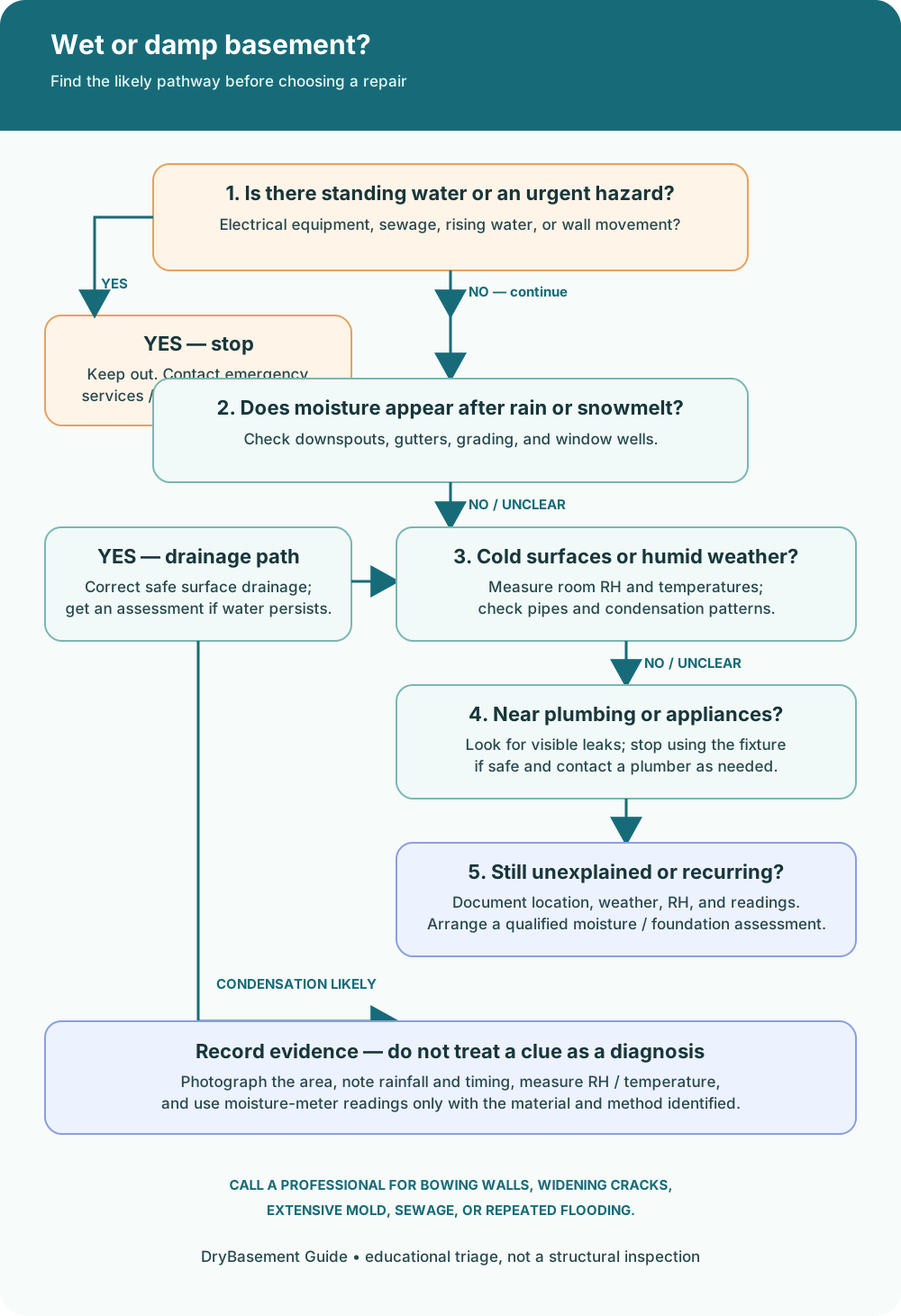
Start: Is there standing water or an immediate safety concern?
- Yes: Keep out of the water. Arrange emergency or qualified professional help as appropriate.
- No: Continue.
Does moisture appear soon after rain or snowmelt?
- Yes: Inspect gutters, downspouts, ground slope, window wells, discharge pipes, and low spots outside—only from a safe location. If these are correct and water still enters, ask a waterproofing or drainage professional to assess the foundation and groundwater pathway.
- No or unclear: Continue.
Is moisture concentrated on cold surfaces or during humid weather?
- Yes: Measure relative humidity, inspect cold-water pipes and ductwork for condensation, and compare outdoor and indoor conditions. Try controlling indoor moisture and operating a properly sized dehumidifier while monitoring results.
- No or unclear: Continue.
Does the damp area line up with plumbing, a bathroom, water heater, laundry, or appliance?
- Yes: Stop the relevant fixture if safe and arrange a plumber where needed.
- No: Continue.
Is there persistent odour, mold-like growth, soft timber, or moisture behind finishes?
- Yes: Avoid disturbing suspect growth or opening walls blindly. Investigate hidden moisture and contact a qualified mold or building professional when the area is extensive, recurrent, or the cause is not clear.
- No: Continue logging observations; a professional moisture assessment may still be warranted.
This flowchart narrows the possibilities. It does not replace an inspection of the actual building.
Step 4: Check outdoor drainage before buying coatings
The University of Minnesota Extension recommends addressing indoor moisture sources, gutters, downspouts, and surface grading before moving to more extensive drainage systems. See its basement moisture guidance.
From ground level, check that gutters are not overflowing, downspouts discharge away from the foundation in a lawful location, and soil slopes away rather than forming a trough at the wall. Do not direct water onto a neighbour’s property or where it may damage a sidewalk, septic system, or foundation. Buried drainage work, excavation, and grading near utilities require appropriate planning and professional help.
Step 5: Measure before and after
An inexpensive hygrometer can help identify high indoor humidity; a moisture meter may provide comparative readings on suitable materials. Meter results depend on the instrument, material, calibration, salts, temperature, and where it is placed. A reading on concrete is not directly interchangeable with a reading on wood or drywall.
Record instrument make and model, the material, measurement location, date, and conditions. Compare repeated measurements at the same spots, but do not use one number to declare a wall “dry” or to rule out hidden water. Our own basement moisture readings have not been supplied for this guide, so no first-hand test result is claimed.
What might repairs cost?
The figures below are broad US planning ranges, not quotations. Published national guides differ because they describe different project scopes. The 2026 Angi guide reports that many professional waterproofing projects fall around $2,460–$8,205, while complete excavation or complex systems may cost much more. See Angi’s current cost guide.
| Type of work | Indicative US planning range | Important limitation |
|---|---|---|
| Minor, accessible crack or local repair | $500–$2,500 | Only appropriate after confirming the crack and water source |
| Limited drainage or pump work | $1,000–$5,000+ | Scope varies sharply by discharge route and excavation |
| Interior perimeter drainage / pump system | $3,000–$10,000+ | May exclude finished-room restoration or complex access |
| Exterior excavation and waterproofing | $7,000–$20,000+ | Soil, depth, access, landscaping, and foundation condition drive cost |
| Mold cleanup or material replacement | $500–several thousand dollars or more | Extent and affected materials determine the price |
Use at least two or three written, itemised quotes for larger work. Ask each contractor to explain the diagnosed source, what the proposed system does and does not solve, permit requirements, discharge location, warranty conditions, restoration work, and maintenance.
Mistakes to avoid
- Painting over a damp wall without addressing active water.
- Assuming every white deposit is mold; efflorescence is a different phenomenon.
- Ventilating a cool basement with hot, humid summer air without checking condensation risk.
- Treating a dehumidifier as a solution to active leakage or groundwater pressure.
- Comparing quotes that describe different lengths of drain, excavation, or finished-room restoration.
- Using a DIY test or a single moisture-meter reading as proof of structural safety.
Frequently asked questions
Does a damp basement always need waterproofing?
No. Condensation, a leaking appliance, a blocked downspout, and groundwater seepage need different responses. Diagnose the source first.
Will a dehumidifier stop water coming through a wall?
It can reduce airborne moisture and condensation, but it does not stop active liquid water entering through cracks or joints.
Is a white powder on a basement wall dangerous mold?
Efflorescence is generally mineral salt left behind when moisture evaporates from masonry. It still signals moisture movement, and the cause should be investigated.
Should I seal a crack from the inside?
Some non-structural cracks can be repaired with suitable systems, but active leaks, moving or widening cracks, and bowing walls require professional assessment before selecting a repair.
When should I call a professional?
Call promptly for standing water, suspected electrical hazards, sewage, recurring leaks, extensive mold, soft or decaying timber, a bowing wall, widening cracks, or signs of movement.
Explore the full basement moisture guide series
Use these supporting guides to work through each decision in more detail:
- Condensation or leak? How to use the foil test carefully
- Musty basement smell: causes and fixes
- Best dehumidifier size for your basement
- Ideal basement humidity level
- Efflorescence on basement walls
- Interior vs. exterior waterproofing costs
- Sump pump size and battery backup
- Crawlspace encapsulation explained
- Gutters and grading to keep basements dry
- Basement flooded after heavy rain: what to do first
- Sealing basement floor and wall cracks
- Window well drainage
- Basement flooring for damp spaces
- Mold vs. mildew: when to test or call a pro
Sources: University of Minnesota Extension; US EPA: Mold, Moisture and Your Home; Angi: Basement Waterproofing Cost (2026).
First-hand evidence to add before publishing: Insert original photos of the home’s observed symptoms and a table of genuine moisture-meter / humidity readings, instrument, date, material, location, and weather. Do not imply that a test was performed until you have those observations.
Record when the moisture appears, where it starts, and what changes after rain or dry weather. If water is near electrical equipment, flooding is active, or the foundation may be moving, treat safety as the priority.
Sources and corrections